How to Calculate Anion Gap With Total Carbon Dioxide
What’s the Anion Gap?
The anion gap is a calculated value that assists clinicians assess acid-base balance and identify certain acid-base disorders. It is calculated from common electrolytes measured on a serum chemistry panel or basic metabolic panel. The result indicates the difference between measured positive ions and measured negative ions in the blood, which gives useful insight into unmeasured ions that may be present.
In practical terms, the anion gap is most often used to help evaluate whether a patient has metabolic acidosis and, if so, whether it is a high anion gap process or a normal anion gap process. Because the calculation depends on routine lab values, it is a rapid and widely used diagnostic tool in clinical chemistry and bedside interpretation.
An anion gap calculator can make easier the math, but understanding the underlying formula is essential. The value is not a direct measurement; it is an estimate that supports broader acid-base status analysis. That means the clinical significance depends on the full context, including symptoms, other chemistry results, and the patient’s overall condition.
How Exactly Does Total CO2 Relate to Bicarbonate
Total CO2 on a chemistry report is strongly linked to bicarbonate, and that is why it is often used in anion gap calculations. Most of the measured total CO2 in blood reflects serum bicarbonate, while a smaller portion comes from circulating carbon dioxide and carbonic acid. Because bicarbonate makes up the largest share, total CO2 is commonly treated as an estimate of bicarbonate in routine interpretation.
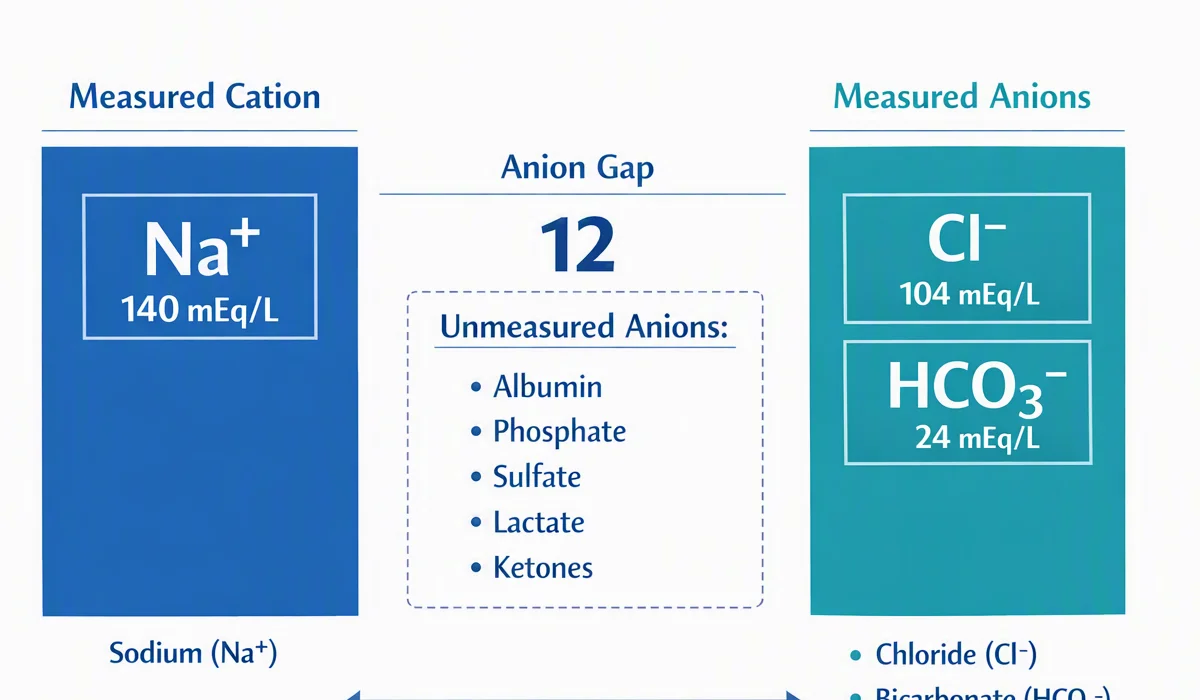
This connection matters because many clinicians use total CO2 as a practical substitute for bicarbonate when calculating the anion gap. On a serum chemistry report, total CO2 is usually the number you will see rather than a separate bicarbonate result. In that setting, the measurement is adequate for most standard comparisons and can support a useful diagnostic result.
However, total CO2 is not identical to bicarbonate in every situation. Small differences can occur due to specimen handling, timing, or lab methodology. For that reason, it is important to interpret the number in context rather than assuming it is always a perfect one-to-one match. Still, for routine bedside and outpatient use, total CO2 generally acts as a practical proxy for bicarbonate in the anion gap calculation.
Formula for Anion Gap With total CO2
The basic anion gap equation looks like:
Anion gap = sodium - (Cl + total CO2)
In this calculation, sodium serves as the main measured cation, while chloride and total CO2 act as the main measured anions. Since total CO2 typically approximates bicarbonate, the formula can be used even when a separate bicarbonate value is not provided. The calculation highlights the difference between measured cations and measured anions, which is the core of the analysis.
Some clinicians and laboratories follow variations of the formula that include potassium, but the most common clinical approach leaves out potassium and relies on sodium, chloride, and total CO2. That gives the calculation easier and more consistent across standard electrolyte panel results. If you are using an anion gap calculator, confirm which formula it follows so the result aligns with the expected range used by the lab or institution.
When using total CO2 in place of bicarbonate, the key idea is that the result approximates the amount of unmeasured ions in the blood. A higher-than-expected value may point toward unmeasured anions, while a lower value may suggest bicarbonate loss or acid accumulation. This is why the formula is so valuable for acid-base interpretation.
Step-by-Step Example Calculation
A basic calculation example can make the procedure clearer. Consider the laboratory values on an lab panel show sodium of 140, chloride of 102, and total CO2 of 24. With the formula:
anion gap = 140 - (102 + 24)
anion gap = 140 - 126
anion gap = 14
The outcome is then weighed with the lab’s expected range. If the lab’s normal range for anion gap is, for example, 8 to 16, then 14 falls within the normal limits. Clinical interpretation always depends on the lab-specific reporting range, because normal limits differ depending on the analyzer and reporting method.
Below is another example using different lab values. When sodium is 136, chloride is 110, and total CO2 is 18, then:
anion gap = 136 - (110 + 18)
anion gap = 136 - 128
anion gap = 8
While the anion gap itself is not elevated, the low total CO2 suggests reduced bicarbonate, which may still indicate a disorder of acid-base balance. This shows why the result should always be interpreted with the rest of the chemistry panel, not in isolation. The pattern of sodium, chloride, and total CO2 together gives the most useful comparison for clinical analysis.
What a High Anion Gap Means
A high anion gap often indicates the presence of unmeasured acids in the blood and is a classic clue in metabolic acidosis. When total CO2 is low and the anion gap is elevated, the body may be building up acid faster than it can buffer or remove it. This pattern is important because it helps pinpoint the cause of the patient’s abnormal acid-base status.
Common causes include lactic acidosis and ketoacidosis. In lactic acidosis, excess lactic acid collects when oxygen delivery or tissue perfusion is impaired. In ketoacidosis, ketone bodies increase, often when insulin is absent or carbohydrate use is altered. Both conditions can produce a clearly elevated anion gap and a decreased total CO2 result.
Other causes of a high anion gap exist as well, but the clinical workflow often starts with these major categories. The key point is that a high anion gap indicates more than a lab figure; it is a signal to perform a broader diagnostic analysis. The pattern, symptoms, and accompanying lab values all are important when interpreting the result.
When the anion gap is high, the total CO2 is often low because bicarbonate is being consumed to offset excess acid. That relationship explains why the calculation is so useful in identifying hidden acid loads. An anion gap calculator can confirm the arithmetic quickly, but interpretation still requires clinical judgment and comparison with other findings.
What a Normal Anion Gap Means
A normal anion gap does not eliminate acid-base disorder. Rather, it often points toward non-anion gap metabolic acidosis, where bicarbonate is removed or chloride goes up to maintain electrical balance. In this setting, the measured anion gap stays within the expected range even though the patient may still have a substantial acid-base problem.
Two common causes are diarrhea and renal tubular acidosis. With diarrhea, bicarbonate is depleted through the gastrointestinal tract, lowering total CO2 and potentially causing acidosis without a large increase in unmeasured anions. In renal tubular acidosis, the kidneys fail to handle acid or bicarbonate properly, again producing a normal gap pattern.
A normal anion gap is therefore not the same as a normal metabolic state. It simply means the difference between sodium and the sum of chloride plus total CO2 is not elevated. That result can still be abnormal if the bicarbonate-related component is decreased or if chloride is increased. The full electrolyte pattern gives the most reliable comparison.
When reviewing a normal anion gap result, pay close attention to the trend in chloride and total CO2. The finding may reflect bicarbonate loss, impaired renal acid handling, or compensation for another disorder. Understanding this pattern is essential for accurate acid-base interpretation.
Common Errors When Using Total CO2
A frequent issue is thinking that total CO2 always equals bicarbonate exactly. UAG calculation for acidosis Even though the values are usually near, differences can occur due to sample handling, testing method, or timing. If a specimen sits too long before analysis, carbon dioxide can escape, and the measured total CO2 may decrease inaccurately. That can create a confusing result and affect the calculated anion gap.
Lab error is another issue to consider. Any unexpected variation in sodium, chloride, or total CO2 should prompt a prompt check of the report and, if needed, repeat testing. A single outlying value can distort the formula and lead to the wrong conclusion about acid-base status. This is especially important when the result does not match the clinical picture.
Albumin also matters because it is a major unmeasured anion in blood. Low albumin can decrease the measured anion gap even when acid-base disorders are present. In those cases, a corrected anion gap may be more useful than the unadjusted value. Failure to account for albumin can cause a hidden high anion gap to be missed.
It is also important to contrast the result with the lab’s reference range rather than relying on a single universal cutoff. Different laboratories may report slightly different ranges based on their methods. A borderline result may be normal in one setting and mildly abnormal in another, so context matters.
Finally, remember that total CO2 is only one part of the analysis. A clinician should always review the full basic metabolic panel or electrolyte panel, including the pattern of sodium and chloride, and consider whether the patient has signs of metabolic acidosis or another disorder. The best interpretation comes from combining calculation, comparison, and clinical context.
Frequently Asked Questions About Anion Gap and Total CO2
How is calculated anion gap using total CO2?
Follow the standard formula: anion gap = sodium - (chloride + total CO2). Total CO2 is commonly used as a practical estimate of bicarbonate, so it can be inserted directly into the calculation for routine interpretation of an electrolyte panel or basic metabolic panel.
Does total CO2 mean bicarbonate in the anion gap formula?
Not exactly, but it is usually close enough for clinical use. A large part of total CO2 reflects bicarbonate, so it often substitutes for serum bicarbonate in the formula. Small differences can occur, so interpretation should consider sample handling and the full acid-base picture.
What is a normal anion gap range
The reference range depends on the laboratory and method used, so there is no single universal value. Many labs report a range that is roughly around the low teens, but always use the range printed with the result. That comparison is the most accurate way to judge whether the value is normal.
Why does the anion gap increase when total CO2 decreases
When total CO2 is low, bicarbonate is usually reduced, which can happen in metabolic acidosis. If the body also has extra unmeasured acids, the anion gap rises as bicarbonate falls. This pattern is common in lactic acidosis and ketoacidosis.
Should albumin be corrected when interpreting the anion gap
Yes, especially if albumin is low or if the result seems inconsistent with the clinical picture. Because albumin contributes to the normal anion gap, low levels can mask a truly elevated gap. A corrected anion gap can improve acid-base interpretation and help reveal hidden disorders.